07/04/2024
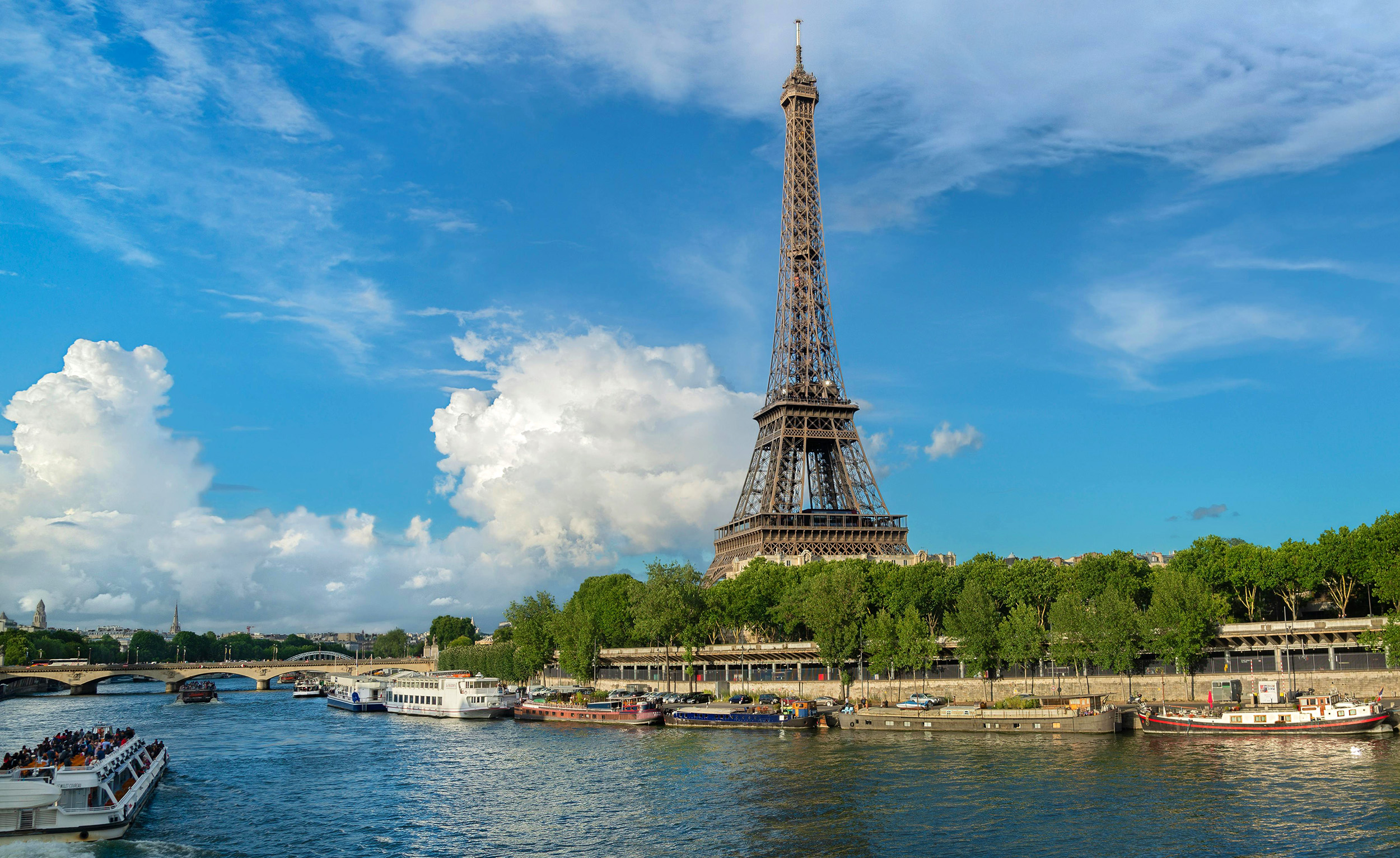
The Eiffel Tower is the best-known landmark of Paris and a symbol of France. It stands on the Champ de Mars by the Seine, in the 7th arrondissement; the long lawns of the Champ de Mars and the Trocadéro gardens across the river are the classic places to photograph it. Together with the other monuments on the banks of the Seine, it is a UNESCO World Heritage Site.
The tower was built in 1887–1889 by Gustave Eiffel’s company as the entrance arch to the 1889 World’s Fair, held for the centenary of the French Revolution. It is made of about 18,000 wrought-iron parts held together by some 2.5 million rivets and, with its antennas, is now 330 metres high. It was meant to be dismantled after twenty years but was saved because it proved useful as a radio transmission tower.
Visitors can go up to three levels: the first floor at 57 metres, with a glass floor; the second floor at 116 metres, home to the Michelin-starred restaurant Le Jules Verne; and the top at 276 metres, with Gustave Eiffel’s reconstructed office. The stairs (674 steps) go only as far as the second floor; the top can be reached only by lift.
Tickets (2026, adults): stairs to the second floor €14.80, lift to the second floor €23.50, stairs to the second floor plus lift to the top €28, lift to the top €36.70; young people and children pay less, and under-4s go free. With about six million visitors a year, it is best to book a timed ticket online in advance. The tower is open every day from about 9:30 to 23:00, and from 9:00 to about 00:45 in summer.
The nearest stations are Bir-Hakeim (metro line 6) and Champ de Mars–Tour Eiffel (RER C). After dark the tower is lit up, and for five minutes at the start of every hour it sparkles with thousands of flashing lights.


Weather in location: Eiffel Tower, Paris, France
Average by month
Monthly averages and dry days (no measurable rain) from ERA5, last 10 years.