14/04/2024
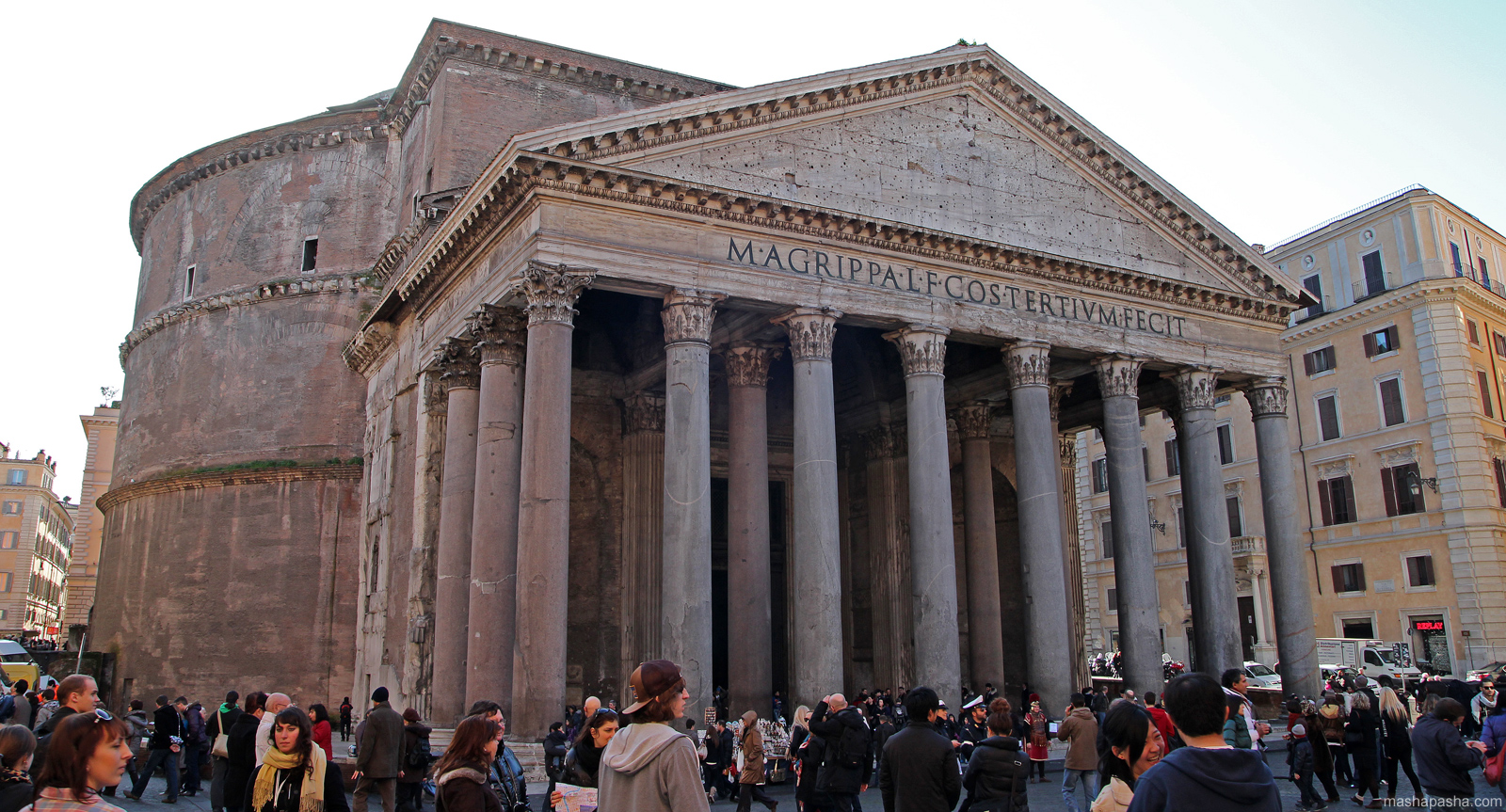
The Pantheon on Piazza della Rotonda is the best-preserved building of ancient Rome and one of the most influential in the history of architecture. Its name means “temple of all the gods”. The first temple here was built by Marcus Agrippa in 27 BC; after fires, Emperor Hadrian rebuilt it completely around 113–125 AD, modestly keeping Agrippa’s name in the inscription on the portico: “M·AGRIPPA·L·F·COS·TERTIVM·FECIT”.
Sixteen granite Corinthian columns, brought from Egypt, carry the portico. Behind it, the round hall is crowned by a coffered concrete dome 43.3 metres across — exactly as wide as it is high — still the largest unreinforced concrete dome in the world. The only light comes through the oculus, an opening about 9 metres wide at the top; when it rains, the water drains away through small holes in the slightly curved floor.
In 609 Pope Boniface IV consecrated the temple as the church of Santa Maria ad Martyres, which saved it from being quarried for stone like so many other ancient buildings. It is still a church today and holds the tombs of the painter Raphael and of the first kings of Italy, Victor Emmanuel II and Umberto I. At Pentecost, firefighters drop thousands of red rose petals through the oculus.
The Pantheon is open daily from 9:00 to 19:00, with last entry at 18:45, and closed on 1 January, 15 August and 25 December. Since July 2026 a ticket costs €7 (€2 for EU citizens aged 18–25); entry is free for under-18s, residents of Rome and everyone on the first Sunday of the month, and for those attending Mass.
The Pantheon stands in the heart of the historic centre, between Piazza Navona and Via del Corso, and there is no metro station nearby: walk about 15 minutes from Barberini or Spagna, or take a bus or tram 8 to Largo di Torre Argentina. The square in front, with its fountain and obelisk, is busy all day, so come early in the morning.


Weather in location: The Pantheon in Rome, Italy
- Today 11°…26°
- Wind 3 km/h N
- No precipitation now
Average by month
Monthly averages and dry days (no measurable rain) from ERA5, last 10 years.