24/07/2019
The Great Pyramids and the Great Sphinx of Giza are among the most famous monuments in the world; the Great Pyramid of Cheops is the only one of the Seven Wonders of the Ancient World that still stands. They are located on a rocky desert plateau in Giza, about 15 km southwest of central Cairo, near the Nile River. In ancient times, the plateau served as a royal necropolis of Memphis, the capital of Egypt. When the pyramids were built, a branch of the Nile reached close to the plateau, which helped to transport the stone.
Key facts about the Great Pyramids:
- Built between about 2600 and 2500 BC by pharaohs of the 4th dynasty of the Old Kingdom of Egypt.
- The complex includes pyramids for pharaohs, queens, funerary temples, and other religious buildings.
- Only three pyramids are considered “great”: Cheops (Khufu), Khafre, and Mikerin (Menkaure).
The Cheops Pyramid is the largest, originally 146 meters high (now about 138 meters), with a base of 230 meters per side. It consists of around 2.3 million stone blocks, some weighing dozens of tons. Inside, visitors can reach the burial chamber of the pharaoh with its granite sarcophagus through narrow passages, though there is little else to see.
Additional features of the Cheops Pyramid:
- Two entrances: one original and one later cut by robbers.
- The sides rise at a steep angle of about 52 degrees.
- Originally covered with polished white limestone casing and probably crowned with a capstone (pyramidion), now lost.
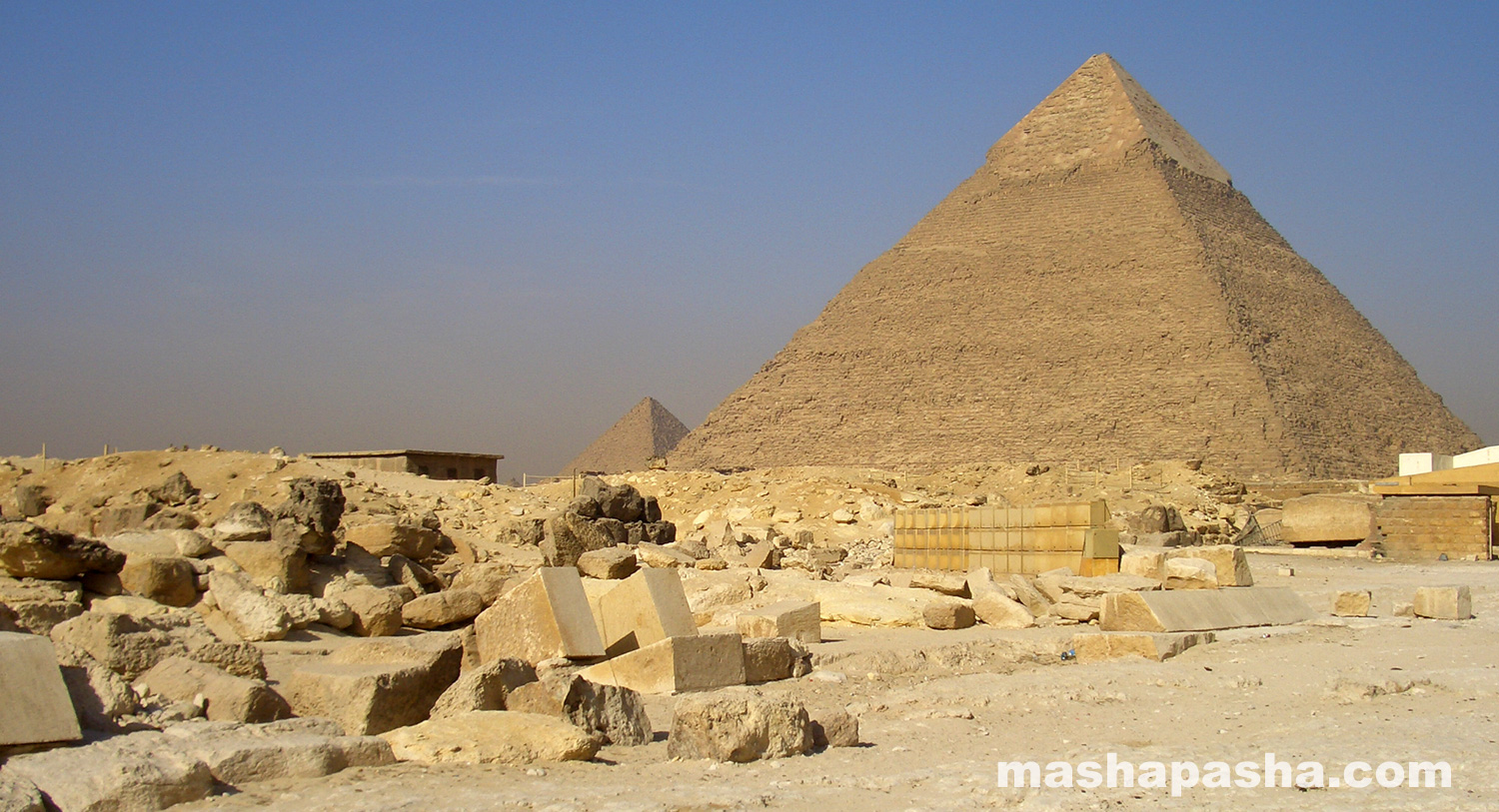
The Khafre Pyramid, slightly smaller at 143 meters, appears taller than Cheops because it stands on a hill. Its distinctive feature is the remaining white cladding at the top. Khafre was Cheops’ son, and his pyramid also contains internal passages not open to tourists. Nearby is the Great Sphinx, carved from a single limestone rock, depicting a lion with a human head, likely representing Khafre. It is 72 meters long, about 20 meters high, and faces the Nile.
Interesting facts about Khafre and the Sphinx:
- The Sphinx lost its nose and ceremonial beard over time.
- The Sphinx and the Khafre Pyramid date to the 26th century BC.
- The sculpture was partially buried over time and had to be excavated.
The Pyramid of Mikerin, the smallest of the three, is about 65 meters high with a base of about 103 meters. Its mortuary temple contains stone blocks weighing up to 200 tons, and how they were moved is still debated. The reconstructed cedar boat of Cheops, 43 meters long, which was found beside the Great Pyramid, is now displayed at the Grand Egyptian Museum nearby.
Visiting tips:
- Entrance to the Giza pyramid complex is paid; additional fees apply to enter the Cheops Pyramid.
- The small pyramids of the queens can be entered with the general ticket but offer little to see.
- Crowds and aggressive souvenir sellers are common; bargaining is recommended.
The Giza plateau remains an essential site for anyone interested in ancient Egyptian history and architecture, offering breathtaking views and a tangible connection to the pharaohs’ legacy.


Weather in location: Great Pyramids & Great Sphinx at Giza, Egypt
- Today 17°…28°
- Wind 13 km/h SW
- No precipitation now
Average by month
Monthly averages and dry days (no measurable rain) from ERA5, last 10 years.