30/07/2026
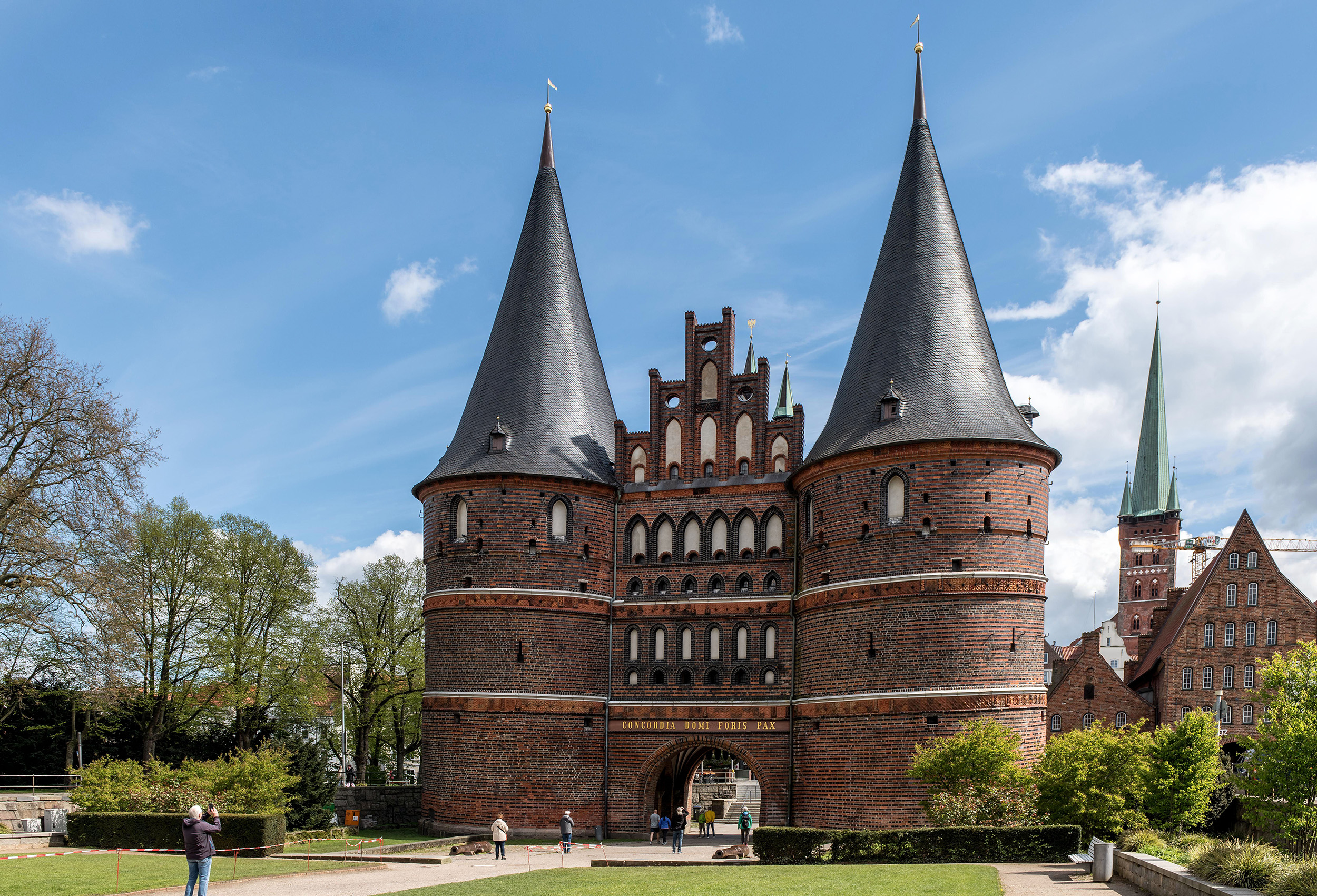
The Holsten Gate (Holstentor) is the emblem of Lübeck and one of the most familiar images in all of Germany — a massive twin-towered gatehouse of dark red brick guarding the western approach to the old Hanseatic city. Built between 1464 and 1478 as part of Lübeck’s medieval fortifications, it is a masterpiece of North German Brick Gothic, its two great round towers framing a pointed archway beneath stepped gables and terracotta friezes. Set on soft, marshy ground, the towers have leaned visibly towards each other over the centuries, giving the gate its characteristic tilt. Bristling with gun-ports yet never once attacked, it carries above its city-facing arch the proud motto “Concordia domi foris pax” — “harmony within, peace without.” Together with Lübeck’s old town it has been a UNESCO World Heritage Site since 1987.
What to See
Most visitors come simply to admire and photograph the gate from the little green square between it and the river, where its twin towers and richly patterned brickwork are seen to best effect — an image so iconic that it once featured on the German 50-mark banknote and on a two-euro coin. Inside, the gate houses a branch of the Lübeck city museum, whose displays tell the story of the great Hanseatic trading city, its merchants and its power, with models of medieval Lübeck, historic arms and armour and a picture of life behind the walls. From the gate it is only a few steps across the River Trave into the old town, where the historic salt warehouses (Salzspeicher) stand immediately alongside and the spires of Lübeck’s brick churches rise ahead. The setting makes the Holstentor the natural starting point for exploring the wider UNESCO-listed Altstadt, with its marzipan shops and medieval merchant houses beyond.
How to Get There and Practical Information
Lübeck lies in Schleswig-Holstein in the far north of Germany, less than an hour by frequent regional train from Hamburg. The Holsten Gate stands right between Lübeck’s main railway station and the old town, only a five-minute walk from the station, so it is usually the first thing visitors see on arrival. The gate and its square can be admired free of charge at any time, day or night; the museum inside keeps regular opening hours and charges a modest admission, and is generally closed on Mondays outside the peak season. As the gateway to the Altstadt, it makes an ideal place to begin a walking tour of the island old town — ideally rounded off with a stop for Lübeck’s famous marzipan.


Weather in location: Holsten Gate of Lübeck, Germany
- Today 8°…16°
- Wind 8 km/h S
- No precipitation now
Average by month
Monthly averages and dry days (no measurable rain) from ERA5, last 10 years.