
Malta
Malta is a compact Mediterranean archipelago between Sicily and North Africa, where honey-coloured limestone cities, walled harbours and Baroque churches meet crystal-clear coves. It`s one of Europe's smallest countries.
General information
Malta is one of Europe's smallest and most densely packed countries — an archipelago of three inhabited islands (Malta, Gozo and Comino) in the heart of the Mediterranean, about 80 km south of Sicily. English is an official language alongside Maltese, which makes travelling here exceptionally easy, and the euro is used throughout. The capital, Valletta, is a UNESCO-listed fortress city built by the Knights of St John, while the whole country feels like an open-air museum of megalithic temples, medieval towns, Baroque cathedrals and Grand Harbour fortifications. The climate is classic Mediterranean: hot, dry summers and mild winters, with the sea warm enough for swimming from roughly June to October.
Transport and how to get there
The country's only airport is Malta International Airport (IATA: MLA), near Luqa, about 8 km south of Valletta; it handles year-round flights from most major European hubs and low-cost carriers. From the airport, an express bus reaches Valletta and the main resort areas of Sliema and St Julian's in 20–40 minutes, and taxis or ride-hailing are readily available. Malta has no railway, but an extensive public bus network (Tallinja) links almost every town for a flat fare, and frequent ferries connect Valletta, Sliema and the Three Cities, as well as Malta with Gozo via the Ćirkewwa–Mġarr crossing. Distances are tiny — you can cross the main island in under an hour — so many visitors rely on buses, ferries and the occasional taxi rather than a rental car.
Prices
Prices are approximate and rise noticeably in summer. A mid-range double room typically runs about €70–140 per night, with budget guesthouses from around €45 and four-star hotels €150 and up. A casual two-course meal costs roughly €15–25 per person, a traditional pastizzi snack under €1, and a local beer €2.50–4. The flat single bus fare is about €2 in summer and €1.50 in winter, while the Malta–Gozo ferry costs only a few euros return. Admission to major sites such as St John's Co-Cathedral or the Hypogeum ranges from about €10 to €35 — the Hypogeum is the priciest and must be booked well in advance.
Main attractions
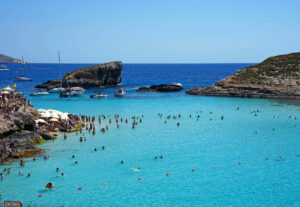
Begin in Valletta with St John's Co-Cathedral and its Caravaggio masterpieces, the Grandmaster's Palace and the Upper Barrakka Gardens overlooking the Grand Harbour. Cross to the fortified former capital of Mdina, the “Silent City”, and neighbouring Rabat. Don't miss the prehistoric temples of Ħaġar Qim and the underground Ħal Saflieni Hypogeum, both UNESCO World Heritage Sites, and the colourful fishing village of Marsaxlokk. On Gozo, the Ġgantija temples, the Citadel of Victoria and Ramla Bay are the highlights, while tiny Comino is home to the famous turquoise Blue Lagoon. Round off any trip with a Grand Harbour cruise or a swim in one of Malta's many rocky coves.