21/07/2026
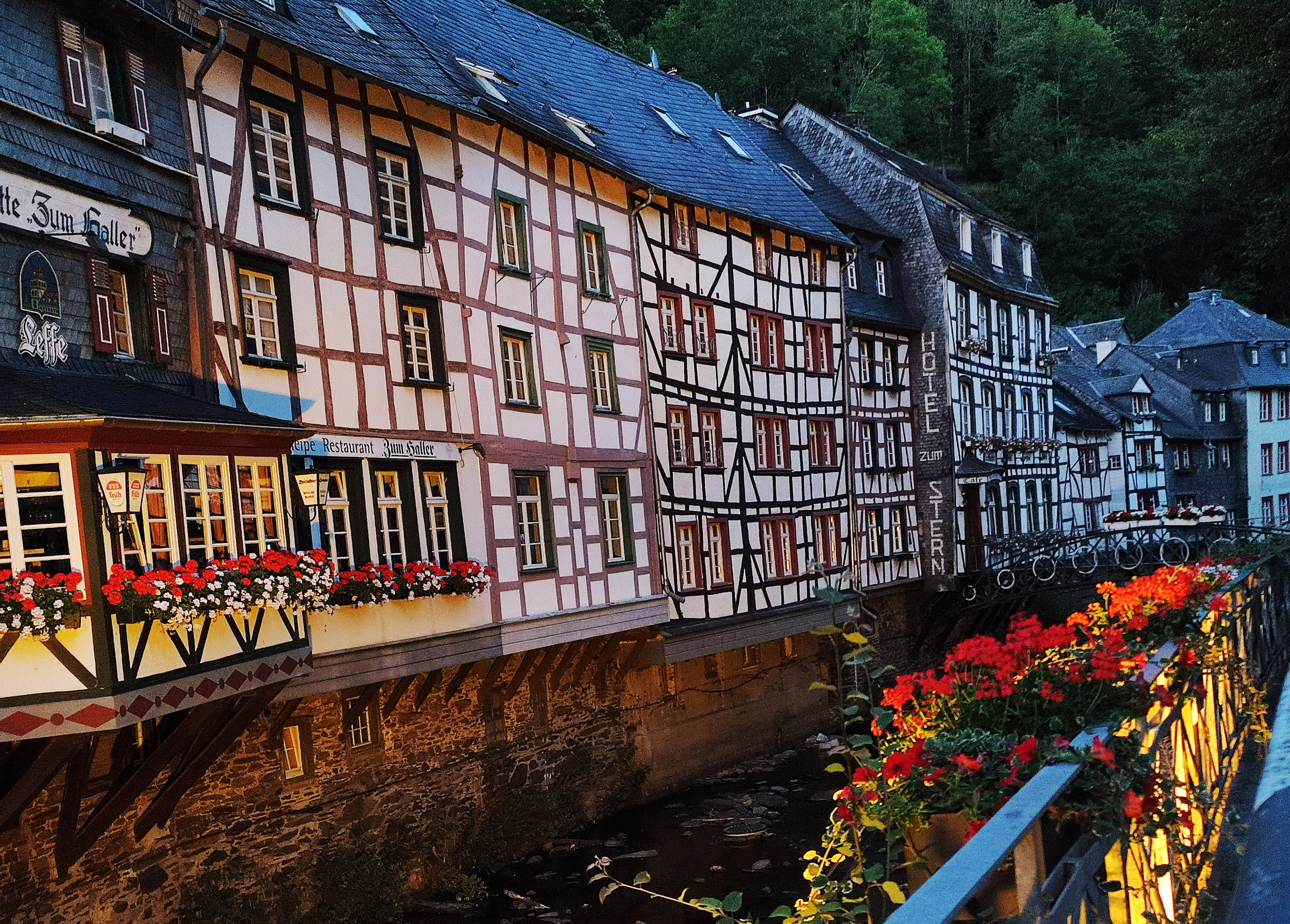
Monschau is a picture-book little town in the wooded hills of the Eifel, in the far west of Germany close to the Belgian border. Its old town huddles in the narrow valley of the River Rur, where more than 300 protected half-timbered houses crowd the steep slopes and press up against sharp bends in the water. Once a prosperous centre of fine-cloth manufacturing in the 18th and 19th centuries, Monschau — known as Montjoie until 1919 — grew wealthy on wool, and the grand merchants’ houses that survive lend its tangle of cobbled lanes an unexpectedly refined air. Because it escaped serious damage over the centuries, the townscape has remained remarkably complete, and Monschau is regularly counted among the prettiest small towns in Germany.
What to See
The undisputed highlight is the Red House (Rotes Haus), a lavish patrician mansion built around 1760 by the cloth manufacturer Johann Heinrich Scheibler as both home and warehouse; now a museum, it preserves complete Rococo, Louis XVI and Empire interiors and a celebrated free-standing carved oak staircase that recounts the story of the wool trade. High above the rooftops stands Monschau Castle (Burg Monschau), a 13th-century hilltop fortress that today houses a youth hostel and stages open-air concerts in summer; the short climb is rewarded with a sweeping view over the slate roofs and the river below. Down in the lanes, the Historic Mustard Mill (Senfmühle), founded in 1882 and still family-run, grinds its seed on old millstones and offers tastings of unusual specialty mustards. Above all, it is the simple pleasure of wandering the Marktplatz, crossing the little bridges over the Rur and admiring the timbered facades, glassblowing workshops and tucked-away cafés that makes a visit memorable.
How to Get There and Practical Information
Monschau lies deep in the Eifel, roughly an hour by car south of Aachen and close to the High Fens (Hohes Venn) nature reserve on the German–Belgian border. It has no railway station of its own, so the usual approach is by car or by regional bus from Aachen (journeys from Aachen Hauptbahnhof take around an hour). Vehicles must be left in car parks on the edge of the centre, as the historic core is largely pedestrianised and its lanes are steep and narrow. Wandering the old town is free at any time; the Red House museum and the mustard mill charge modest admission and keep seasonal hours, so it is worth checking before you travel. Monschau is at its most atmospheric outside peak times — it can be very crowded on summer weekends and during its popular Christmas market — and makes a fine base for walking in the surrounding hills.


Weather in location: Monschau old town, Germany
- Today 6°…18°
- Wind 9 km/h SW
- No precipitation now
Average by month
Monthly averages and dry days (no measurable rain) from ERA5, last 10 years.