26/08/2026
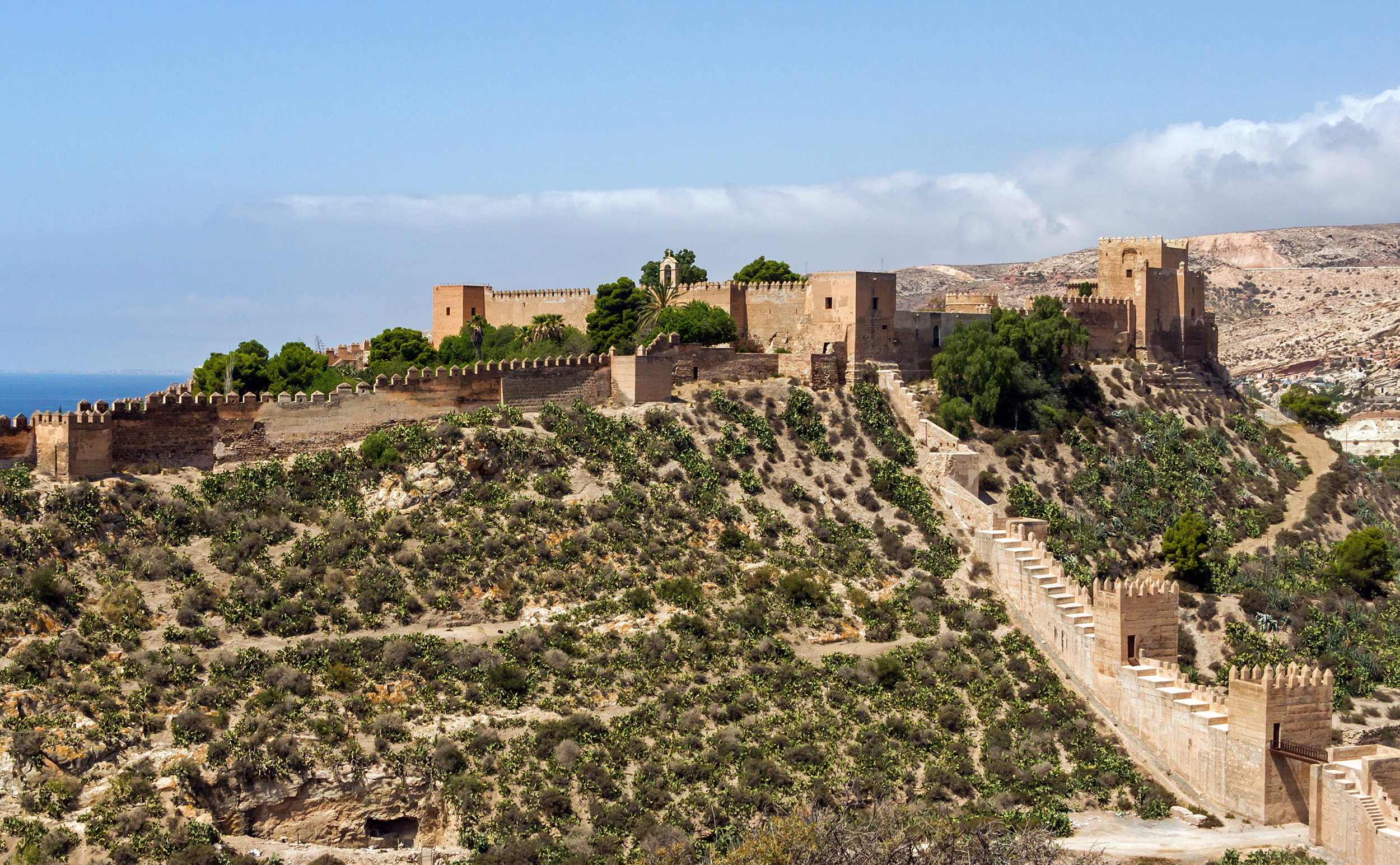
The Alcazaba of Almería is one of the largest and best-preserved Moorish fortresses in Spain, a mighty citadel that sprawls across a hill above the old town of Almería, on the sun-baked coast of eastern Andalusia. It was begun in the 10th century on the orders of the Cordoban caliph Abd al-Rahman III to guard his growing port, and was extended over the following centuries as Almería became a wealthy independent kingdom, or taifa. Enclosing an area of more than four hectares within its triple ring of walls, it ranks among the very largest of Spain’s Muslim fortifications, and its ramparts command sweeping views over the city, the harbour and the Mediterranean.
What to See
The fortress climbs the hill in three walled enclosures, each from a different age. The first is the largest, laid out today as terraced gardens with pools and water channels in the Andalusí style, planted with palms and cypresses. The second held the palaces of the Muslim rulers, of which fragments of walls, cisterns, baths and a small mosque (later a chapel) survive, along with a reconstructed house that evokes daily life in the medieval city. The third and highest enclosure is a later castle added by the Catholic Monarchs after the Christian conquest of 1489, with sturdy towers and a keep in a very different, Gothic-military style. Throughout, the walkways and battlements offer superb panoramas — down over the whitewashed houses of the old La Chanca quarter, across to the walls on the San Cristóbal hill, and out to the blue Mediterranean.
How to Get There and Practical Information
Almería lies on the Mediterranean coast of eastern Andalusia and is served by its own airport and by trains and buses from around the region. The Alcazaba rises directly above the historic centre, reached by a walk uphill from the cathedral and old town — a climb of perhaps ten to fifteen minutes through narrow streets, or a short taxi ride to the gate. Admission is effectively free (nominally free for EU citizens), and the complex is open Tuesday to Sunday, closed on Mondays, with longer hours in summer. Allow at least a couple of hours to explore the enclosures and gardens, wear comfortable shoes and sun protection as there is little shade and many steps, and combine a visit with the cathedral and the atmospheric old quarters below.


Weather in location: Alcazaba of Almería, Spain
- Today 21°…29°
- Wind 14 km/h NW
- No precipitation now
Average by month
Monthly averages and dry days (no measurable rain) from ERA5, last 10 years.